

Exploring personal faults may not make for a good report on the self. Yet, it will provide insight into what should be the correct course of action or suggestions maybe!
When I pick a task, or someone assigns it to me; I instantly assume a lot about the task. My fault is to overthink of all instruction. The fear of misinterpreting the instruction, I often speed off into a whirl of overthinking.
We, at some point in our life, have assumed things. We have failed to understand the importance of it. Only to realise the error or fault, after we reconsider the situation to fully understand why outcome was not as expected.
Sure enough, the situation has moved out of our hands. When it could have been controlled with some cautious self-reflection. Or even seeing it from another person’s point of view. That moment was long gone once communication happens.
Assuming Could Be Quiet Dangerous
When we fail to understand what the task requires from us and just do the needful. Then, we need not overthink the issue at hand.
One of the unfamiliar words that I learnt recently was to have a ‘Transactional Conversation.’ Acquaintances and Colleagues who work with me would be much thankful for.
It is not necessary for a person to have all the answers. The aim should be to get your message through a clear voice of call to action while clearly dispensation of important information.
Make sure to pick that right modes of communication to get your ideas and to garner the needful action from your coworkers or team members.
Transactional Communication
Filtering all the available personal and transactional information into distinct categories.
- Gather all the required research materials
- Decide whether to keep them or to discard them
- Find out if initial levels of interaction required
- Figure out if you need an open conversation or not
- Make the message crisp and to the point
In the past, I have been hinted at for being ambivalent, ambiguous, and circumventing while explaining. These hints did not reveal where I needed to find a fix for the issues.
So then, the reticence to correct the error by being non-communicative did not work either. Since, it is an equivalent of sulking and seems unreasonable.
Let us discover the path by putting numerous factors in place. What happens when an information is communicated and to handle it.
Pointers for Communicating Effectively In All Circumstances
Let us assume for a moment, we have a need to communicate with a person. What should be the required thoughts to have before engaging in a conversation with the concerned person? There are a few things that you should look out:
- Clear idea of what is the need, and the expected end result
- Simple and straightforward description of the need
- If nervous rehearse the voicing of the need
- Make sure it is clear for all concerned
- Voice the need in simple statements
- Countercheck for any misunderstanding
- Reaffirm the duration for completion
- Be available for any clarification, in case of doubts.
In the case of complex task two more steps in needed:
- Cross-check every quarter period or agreed time of checkback of the task’s progression towards the result, to ensure there is no misunderstanding.
- Even out communication to simple doable tasks and present it in simple language of communication.
Foundation of Miscommunication in the Cycle Is Noise
All of us know how communication happens between two people. One is a Sender, other is a receiver. There is a message to share, the sender encodes the message, which is then sent using a chosen medium, and the receiver decodes the message sent to him.
They use media to transfer the message that gets transmitted from sender to the receiver. One way of the above transaction is a partial communication when the receiver responds or gives feedback using the same methods and channel, then that communication has completed one full cycle.
Image for Communication Cycle:
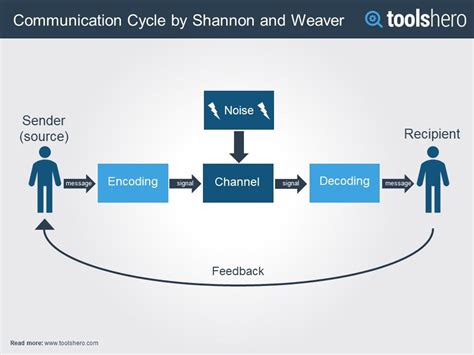
Source: Toolshero – Model by Shannon and Weaver
Different Types of Noise
There are two types of noise one is the External Noise and other is Internal Noise. The external noise is controllable, but the internal noise needs to be addressed by the individual. How noise is tackled and subdued lies in the handling of the latest technology. Innovative technology has reduced static noise and other phone line related noises.
External Noise
The general method to eliminate noises that are external sound is simple enough. One can do so by shifting to a quieter place for a conversation. In such cases, it could be environment induced noise or construction sounds nearby, or traffic, or other unavoidable noises then getting to lesser noise polluted place would help.
Internal Noise
The internal noise is due to the distraction of the sender or receiver engaged in the act of communication. When the message gets skewed up and the quality of transmission may be the best but still the message is not conveyed to the recipient. This leads to much misunderstanding and confusion.
The best way to tackle this issue is to take a few moments to emotionally settle down and then think or even write down what needs to be communicated.
Use a noise free channel and make that connect with a conscious attempt for an effective communication with the concerned person. Being distracted and anxious about a cause or project may seem a little difficult to imagine a proper method to share the information.
Disruption to Communication boils down to misunderstanding something that is being communicated. Whether they happen due to external or internal noises depends on the Channel and sometimes the Sender/Recipient duo.
Clear Communication and Optimum Environment
Then it clearly comes to the fact that you need a clear channel of communication with an optimum external and internal environment to make the communication cycle possible between the sender and recipient. For the message to be transmitted and clearly encoded and decoded by both the persons.
At the juncture of communicating something to another person though without an ideal and conducive environment and noise settings there have been many who have exchanged messages that are utmost importance to both the involved parties.
The art of communication even in an interruptive channel and Sender/Recipient duo mental state gives rise to a skill that is most pronounced for success in leading and being a leader in the team.
 Itinerant Storyteller