The fall on that Saturday felt surreal.
Everything around me seemed to move with a quiet urgency, yet within me there was only a slight daze. I knew something was not right, but that knowing did not immediately translate into panic. It was more like a soft dissonance—an awareness without clarity.
Perhaps it comes from a place I have held for a long time: a deep respect for the medical profession. A doctor’s role, to relieve pain, feels too honourable to critique. Each doctor brings their own way of seeing, their own way of holding a situation. I have never felt the need to measure one against another.
And yet, over the course of that day and the ones that followed, I found myself in three different consultation rooms, each offering not just a diagnosis, but a different experience of care.
My first visit to Sai Ortho gave me a starting point. It grounded me in the physical reality of the fall. Reports—MRI, scan, X-ray—began to define what had happened. The explanation I received was structured, based on what was visible, what could be clinically understood. It told me where I stood.
But even in that space, something else held me.
In the consultation room of the doctor’s father, my eyes rested on an image of Sri Sathya Sai Baba. I did not analyse it at the time. I simply noticed that it steadied me. In retrospect, I realise that even then, something beyond the clinical had begun to support me.
From there, I returned to my physician of the past four years, Dr. Harikrishnan. That decision came instinctively, without much thought. Some relationships are built over time in ways that do not need explanation.
He did not soften the truth, but he did not weaponise it either.
He named my condition clearly. He spoke of procedures with precision. But more importantly, he knew me. He knew that I prefer honesty, but not alarm.
At one point, he let us wait in his office for about twenty-five minutes. Initially, it felt like a delay. But slowly, I began to understand—it was a pause I needed.
Because alongside the injury, another number had entered my awareness: my HbA1c was 11.4.
My mind began to spiral.
It was not just concern—it was a kind of internal whirl, where thinking itself felt slightly unstable. I noticed a faintness, not physical, but in my ability to process.
And yet, the space he held remained calm. His presence did not mirror my anxiety. It steadied it.
Interestingly, the urgency I felt did not come from the doctors. It arose within me. It formed in the space between what was said and how I received it.
He also suggested an orthopaedic specialist for a second opinion.
Back home, there was a brief pause. My brother had stepped out for an eye test at Shankar Netralaya. I reached out to the number given, only to learn that appointments were open from Monday. Time felt like it was narrowing again.
So I called Dr. Harikrishnan and got another contact—Dr. Vijayakrishnan.
He was available only until 3 pm.
My brother returned around noon. We quickly arranged for takeout, and left. There was movement again, but not panic. Just a quiet determination to make it in time.
We reached at exactly 2 pm.
And then, another kind of shock awaited us.
The waiting room was crowded, almost chaotic. The television played Sun Aruvi loudly—songs that felt jarring, almost vulgar in that moment. The space was filled with people, but not with ease. It created a sense of disorientation, a subtle urge to leave.
It was not just noise. It was a misalignment with where I was within.
Eventually, my name was called.
And everything shifted.
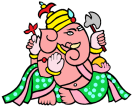
The doctor’s consultation room was filled with Ganesha.
From Bala Ganesha to more mature forms, idols and images lined the space. It was not decorative. It was immersive. A presence that felt both grounding and deeply familiar to me.
There were two rooms, functioning in rhythm—one for consultation, one for examination. Patients moved between them. And within this movement, I noticed more layers.
A small Ganesha waterfall.
A gilded Buddha statue.
Water in motion. Stillness in form.
Even a quiet dog, alert but calm, part of the clinic’s environment.
It struck me that this space allowed for gentleness to exist alongside clinical care.
When the doctor entered, he carried a kind smile and kind eyes.
And something in me broke—not outwardly, but within. A composure I had been holding gently loosened.
It felt, quite simply, like I had arrived at the right place.
I tried my best to hold myself, not to break down emotionally. The consultation moved forward. He suggested an X-ray of my right shoulder.
When I returned after the X-ray, curiosity arose in me. I found myself asking about his Ganesha collection. It was a small moment, but also deeply personal. A recognition—someone as drawn to Ganesha as I am.
There was warmth in that exchange. A human bridge, beyond roles.
He looked at the X-ray and said, “It seems the wound is healing well.”
No surgery.
Instead—an injection, a gel, ice packs, and painkillers only when necessary.
After all the internal spiralling, that sentence did not just offer medical clarity. It returned space to me.
Around that time, something else happened.
The room, which had been full, began to empty. Light entered more freely. It brightened, subtly but noticeably.
And within me, there was a spurt of energy.
I tend to notice such moments. Not in a searching way, but as an attunement. I experience the body and the space around it almost as one continuous field.
In that moment, everything aligned—the light, the space, the response, the words I had just heard.
It felt like confirmation, but not in a logical sense. More like a quiet inner settling.
And then, in a very human turn, we made a small mistake.
We left the clinic without collecting the prescription or paying the doctor.
A few streets later, we realised and turned back.
There was something almost tender about that. After so much intensity, the mind had loosened just enough to forget the practical.
We returned, completed the process, and during the injection, I shared my blog—Mascot of the Itinerant Storyteller. He received it warmly, shared his number, and I promised to send him a Ganesha image.
By the time I returned home, my body finally allowed itself to rest.
And in that stillness, another awareness surfaced.
Dr. Srinivasan—my first consultation—remained unacknowledged in the rush of the day.
I sent him an apology voice message.
Not because I had done something wrong, but because I value the time and attention he had given. There was a quiet sense of responsibility in closing that loop.
And yet, alongside that, a clarity remained.
The second opinion had brought me calm.
Not because one doctor was better than another, but because that particular space, that particular presence, met me where I was.
And as I reflect on the entire journey, I see that each space held something essential.
Sri Sathya Sai Baba in the first room.
Ganesha, Buddha, water, and a quiet dog in the third.
And later, both Shirdi Sai Baba and Sri Sathya Sai Baba together, in abhaya hasta—the gesture of reassurance.
Even outside, on a shop window, the presence continued.
It was not confined to clinics. It followed me out, gently, consistently.
This journey was never just about diagnosis or treatment.
It was about how I moved through spaces.
How I received what was said.
How my body responded.
And how, somewhere between medicine and meaning, I found alignment.
Three doctors.
Three ways of seeing.
And somewhere within them,
a way of listening—
to both the world,
and myself.
Credit: Assisted by Mira AI powered ChatGPT
 Itinerant Storyteller