
The Female of the Species
Sometimes,
You want to talk about
Love and despair and the ungratefulness of children
A man is no use whatever then.
You want then,
Your mother,
Or, sister
Or, the girl with whom you went through school
And your first love,
And her first child—a girl,
And your second.
You sit with them and talk.
She sews
And you sit,
and sip
And speak of the rate of rice
And the price of tea,
And the scarcity of cheese.
You both know
That you’ve spoken
Of love and despair
And ungrateful children.”
(~ A Short Poem)
Multiple-Levelled Poem
Gauri Deshpande’s poem “The Female of the Species” is a poignant reflection on the females among the human species. The natural flow of women’s camaraderie toward other females going through relatively similar experiences is beautifully captured.
Women are generally emotional beings, but when hardships harden them in life, it shows their inner strength gained through sufferance. Their attachment towards the unrecognised labours of love they put into their daily life and their unspoken solidarity is commendable.
There is no sharing of real-life incidents causing mutual emotional distress. At least in this poem, the poet gives sweeping general statements of unrelated daily life. These women showcase their invisible inner strength, not for recognition but for understanding.
A woman’s strength is her natural organising capabilities and her intuitiveness, which are gifts from nature. She, who takes on more than the lion’s share of the family burden, remains silent throughout to meet the social requirement of a peaceful household.
Simple Words in the Poem
The poet has written this poem in free verse. She has also cashed in on the power-packed emotional complexities with simple, everyday words. The poem aims to capture the nuanced ways women communicate among themselves, creating a protective field of lean-in connection.
The fact that their deepest emotions get shared through their conversations about pricing and provisions becomes her emotional moot point. Whenever they might find time to gather, to converse, and to share their woes without mentioning them explicitly, it is a rare confluence of emotional understanding that is reciprocated.
Deshpande’s poem, being non-intrusive and stating the fact as is, draws out with unlimited ease an understanding of simple everyday words. Sometimes, poetry without saying things explicitly can become a source of suggestive hints about larger texts of drawn inferences.
Suggests a Seemingly Low-Key Undercurrent
There is a nice word in the Tamil Brahmin dialect — Haayshiyam! It reflects the fact that a lot is spoken without being articulated or spoken out loud, almost suggesting the probability of something underlying beneath the simple words.
Women find it difficult to outgrow their upbringing. You are bound by so many rules and regulations that speaking about the oppression within a family becomes difficult. Often, they are taught not to rock the boat of married life, but to manage their new household as silent and all-bearing virtuous women. She is then left with very little power and loads of emotional baggage.
Women in Group Solidarity
Their strength, derived from being in a close circle of other women going through similar oppression, provides them a vent in the silence between casual conversations on weather and prices. The sharing of their experiences will not provide them any change other than the strength to bear it up.
I remember post marriage and the shift to another country — I didn’t have a support group since I always walked alone in my life. Life’s lessons were understood and carried out through inner understanding and acceptance. Even at school and college, I rarely had any close buddy with whom I shared everything.
When a woman stands within a circle of warmth from other women, she gains understanding. She also gains an inner core strength to double up her hardship tolerance level. Such communal meetings are more popular when there is an NGO or social drive creating a unifying group of women in a community.
Women’s Life Hinges on Marriage
After my college and a few years of wandering through some computer courses, I picked my collection of poems from high school to college and created a hard copy for publication in 2000. I sat down to write about my perspective as a woman and the restrictions from the multiple rules I encountered around me.
This was written around 1998, and I dusted it occasionally in the interim. I made structural changes in April 2025. It is not as positive as Gauri’s outlook, since my views are about women who are not seen — whispering, unheard voices — women who are just invisible maids who support their partners unconditionally.
Maid for Marriage
By Srividya Suryanarayanan
A maid for marriage
Often made for Marriage.
A slave in market stood.
For marriage brokers,
To brood and dissect
Over columns classified.
Merely as statistics
Was she described
Her height,
Her weight,
Her skin tone,
Optional grades.
Never had she to them,
A human heart,
Never was She found.
She was just a maid,
Meant for a showcase
While greedy eyes
She is ogled
Those sick eyes
Chose wealthy chic
Expect to be decked in
Fat jewels and lean looks.
She a birth machine!
New trends enter
With modern bidder
Demanding of her,
A working juggernaut
Sans identity, sans voice
Sans presence at all!
Worked leaner still
Fighting growing bills.
The matrimonial market
An unjust funny place,
Where two beings
Never really stood,
In the end barter,
Did come through!
They sold her
Then, in familial
Crass sadistic joy
To the lowest bidder.
(SVS – Summer 1998, Revised on 30 April 2025)
What Are We Teaching Our Children
What we teach our children needs to be seen with a new perspective and change. Over the centuries, marriage hasn’t become a choice. Social milestones are still enforced on a woman. She is never free to decline such future arrangements and is grown for the slaughterhouse, at least in conservative circles.
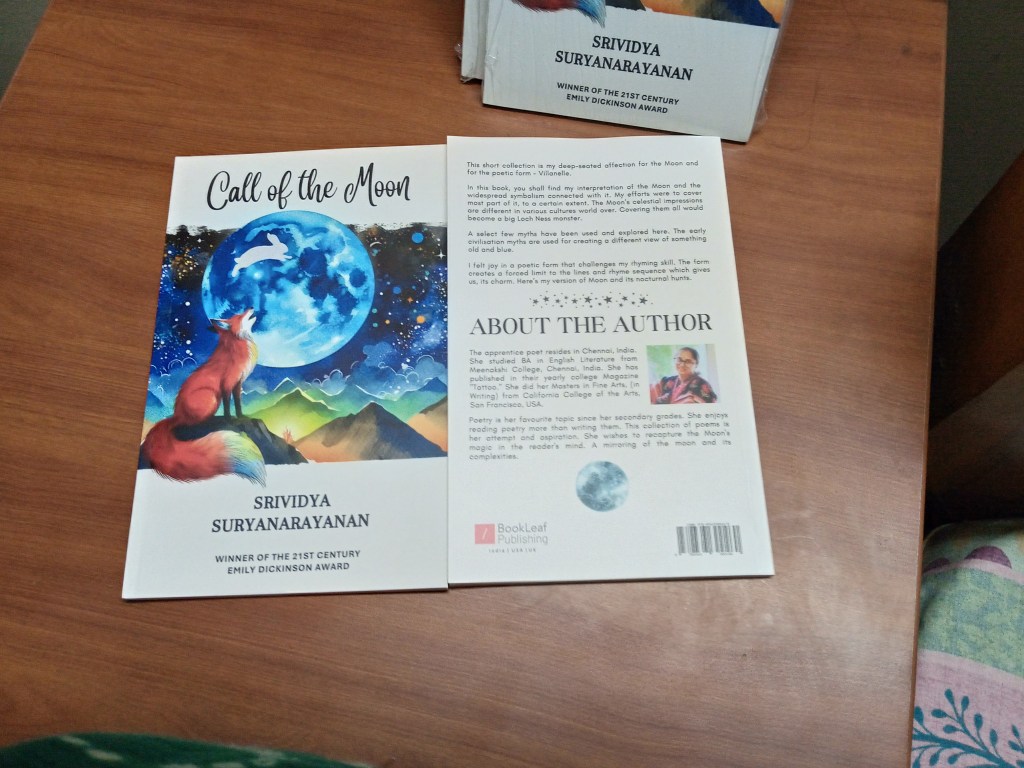
Last year, I wrote a collection of villanelles and sadly indulged in self-publication of these poems. As part of a Poetry Writing Challenge in July 2024, I found at the end of the exercise that my poem lacked my usual storytelling, but under the guise of a conversation with my alter-ego, the Moon, I shared my unrefined sadness.
Book is available in Amazon India, Amazon US, Barnes & Nobles, Flipkart, eBook in BookLeaf Publishing, eBay au, eBay UK
Book Details
Title: Call of the Moon
Poet: Srividya Suryanarayanan
Publisher: BookLeaf Publishing
Mode: Self-Publication
Year of Publication: 2024
ISBN: 9789363300460
A Little About the 2024 Collection
In the 2024 collection, I have played along with the Moon as a central figure, but there is much about social expectations, injustice, unfair dealings, and such other topics — much like women sitting down for a conversation that does not happen, yet the understanding between women still happens.
For me, poetry is a way of thinking emotionally aloud. I have been writing even during the lowest points in my life. The feeling of venting into a Word document is a catharsis for me, which I willingly engage in such expressions. Since I never had any close buddy to share things with, I loved being alone with my thoughts under the cloak of the starry night sky.
The innumerable visits to the terrace while spending time alone, so I could think aloud, resulted in me sneaking upstairs. My mother’s take on my post-dinner visits was that I was possessed by an evil spirit. The resident evil had to be rid of through complex shamanic rituals, as advised by her elder sister.
My mother found solace in her elder sister’s advice as the only route out, and she could not see the existing inner clash in my thoughts. Education speaks of freedom and independence, but reality is a far cry from those learnt lessons.
It was quite a hilarious event for me, but my mother suffered mortal scares without any scientific basis to them, and her limited knowledge and her close circle that couldn’t provide her with better solutions. The solidarity that Gauri Deshpande speaks of — does that include the false beliefs women hold, fed to them throughout their growing years?
Women’s Superstitions and Solidarity
We also need to look at rural and urban women’s sets of superstitions that keep them together, working from that level of perception shaped by their trained world. In all this, I found the poem raising more questions than providing answers for me.
Source: Poem from Facebook Group
Credit: Proofread by Mira (AI Powered ChatGPT)
 Itinerant Storyteller