There is something deeply humbling about beginning with a blank outline.
A line drawing does not rush you. It waits. It asks for attention before it asks for colour. And somewhere in that quiet waiting, it begins to mirror an inner process, one that is less about finishing and more about seeing.
Working with these four thangkas became that kind of journey. What began as an act of colouring slowly unfolded into a conversation with stillness, symbolism, and self.
The First Encounter: Learning to See Beyond Lines
At first, the instinct is technical.
Close the gaps. Prevent colour spill. Stay within the form.
But very quickly, something shifts. The lines are no longer just boundaries. They become invitations. Every curve of a lotus, every fold of a robe, every ornament begins to carry intention.
You realise that these drawings were never empty. They were already complete in their own language. Colour simply becomes a way of listening.
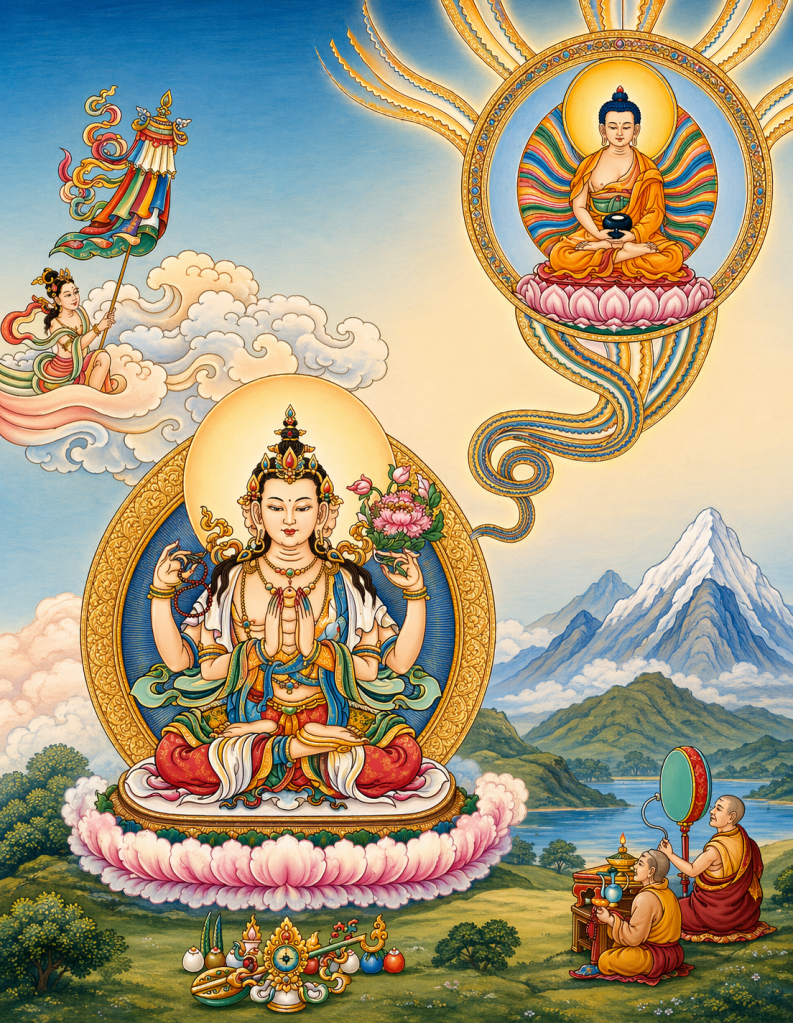
Avalokiteshvara: Compassion as Spaciousness
In the first thangka, the presence of Avalokiteshvara feels expansive.
The composition opens outward. Mountains, water, sky, and human life all coexist within the same visual field. Colouring this image is less about filling and more about balancing. Soft blues for distance, gentle greens for life, muted golds for sacredness.
Compassion here does not feel dramatic. It feels spacious. It allows everything to exist without urgency.
And somewhere in that process, you begin to understand that compassion is not always an act. Sometimes, it is simply the ability to hold.
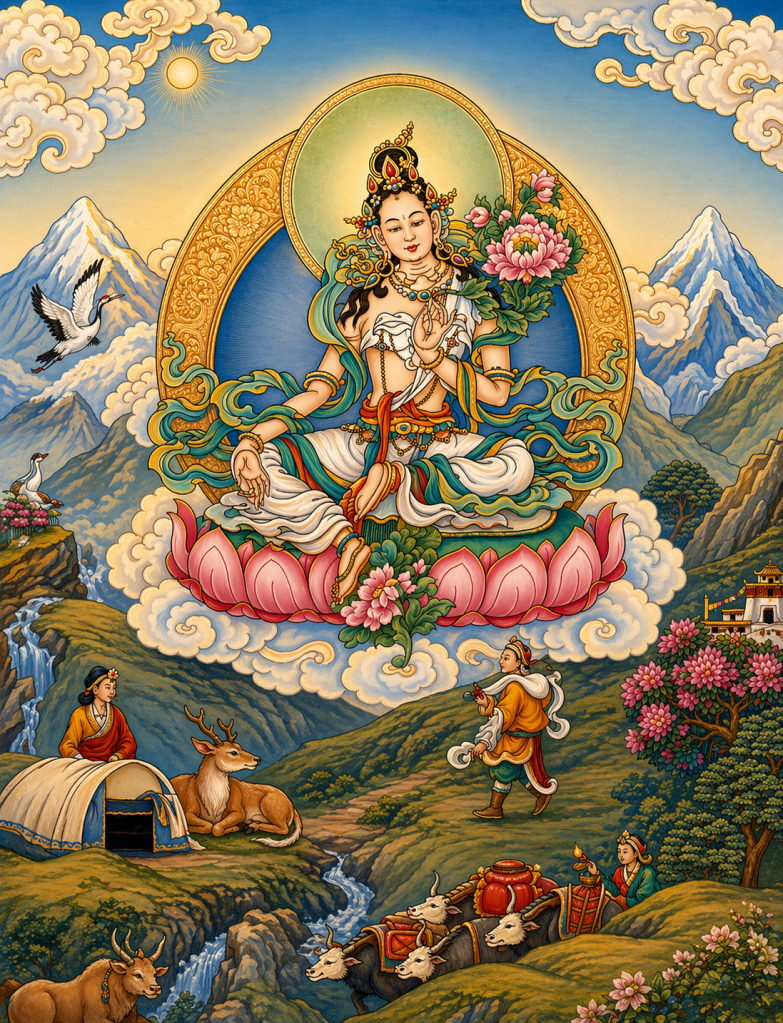
Green Tara: Movement Within Stillness
The second thangka carries a different energy.
There is grace, but also readiness. Flowing drapes, organic lines, and a sense that stillness is not static. Choosing colours here becomes an exploration of movement. Fresh greens, soft pinks, and luminous skin tones bring a living quality to the image.
Green Tara does not wait passively. She responds. And while colouring, that responsiveness becomes almost tactile. The hand moves with more confidence, less hesitation.
It feels like learning that calmness and action do not oppose each other. They belong together.
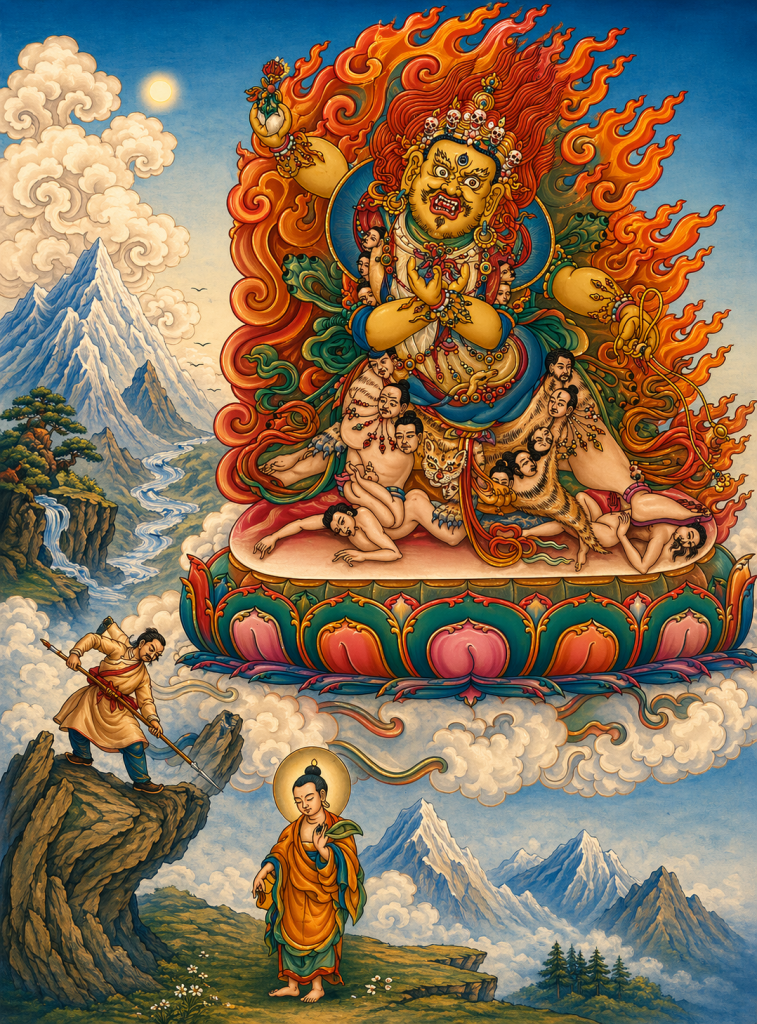
Vajrapani: Power Without Apology
The third thangka changes the atmosphere entirely.
Here, the lines are intense. Flames rise, expressions sharpen, and the visual language becomes unapologetically fierce. Colouring this requires a different kind of courage. Deep blues, burning oranges, and high contrasts replace softness.
At first, it can feel uncomfortable. But slowly, it reveals something important. Not all forms of protection are gentle. Some are direct. Some are loud.
Vajrapani does not dilute strength to make it acceptable. And in engaging with this image, you begin to question where you might be softening your own boundaries unnecessarily.
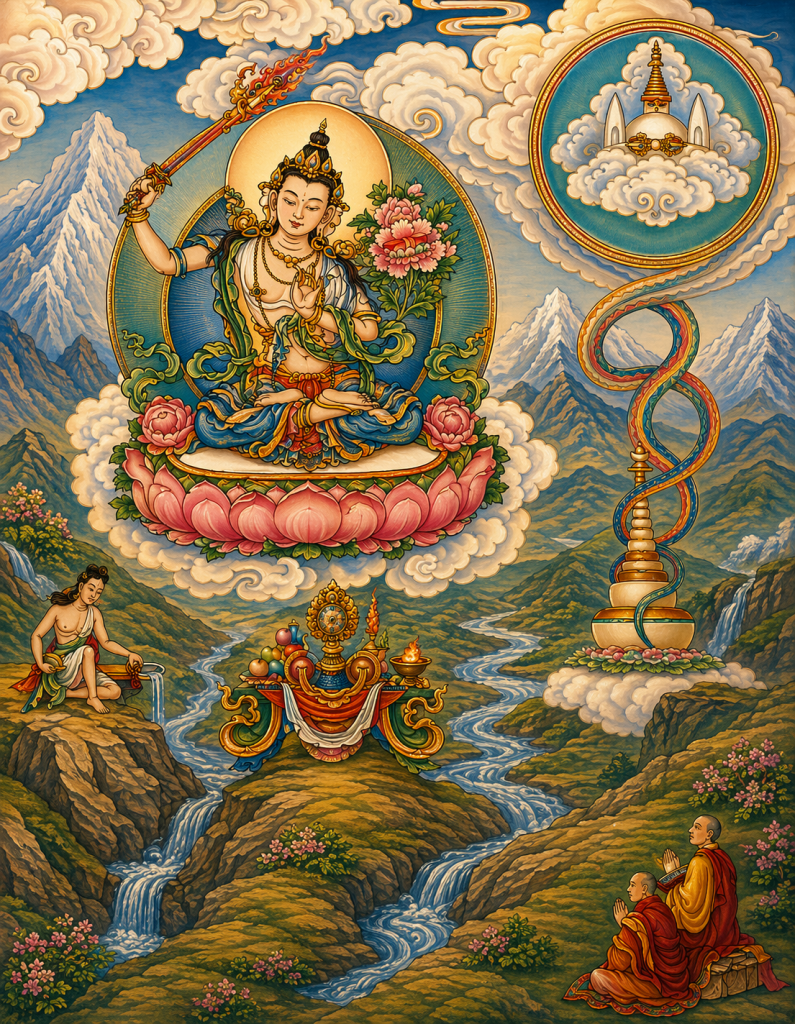
Manjushri: Clarity as Lightness
The final thangka brings a quiet refinement.
The details are intricate, but the energy is clear. The sword, the posture, the surrounding elements all point toward discernment. Colouring here feels precise, almost meditative in a focused way. Golds become sharper, blues cleaner, whites more intentional.
There is less emotional turbulence and more clarity.
Manjushri does not overwhelm. Instead, he simplifies. And through that simplicity, something within also begins to settle.
What the Process Leaves Behind
By the end of these four, the act of colouring is no longer about aesthetics.
It becomes a practice of attention.
You begin to notice how you choose colours. Where you rush. Where you hesitate. Where you feel drawn in. Where you pull away. The images do not just receive colour, they reflect the one who colours them.
And perhaps that is what makes thangkas different.
They are not merely artworks to be completed. They are spaces to be entered.
Between Tradition and Modernity
There was also a quiet negotiation throughout this process. Holding traditional colour palettes while allowing for a more modern aesthetic.
It is not always easy. Tradition carries weight. Modernity seeks freedom. But when they meet gently, something new emerges. Not a replacement, but a continuation.
A way of saying that sacred forms do not need to remain distant. They can live within contemporary expression without losing their essence.
A Closing Thought
These four thangkas did not teach through instruction. They revealed through presence.
Compassion that holds.
Action that flows.
Strength that protects.
Clarity that simplifies.
And perhaps, more quietly than all of these, they offered one more learning.
That sometimes, the most meaningful work we do is not about creating something new, but about learning how to sit with what is already there, and allowing it to unfold, one colour at a time.
Credit: Mira AI Powered ChatGPT
 Itinerant Storyteller