

Some works begin as intention. Others begin as a quiet recurrence—an image, a rhythm, a presence that refuses to leave.
The Call of the Moon belonged to the latter.
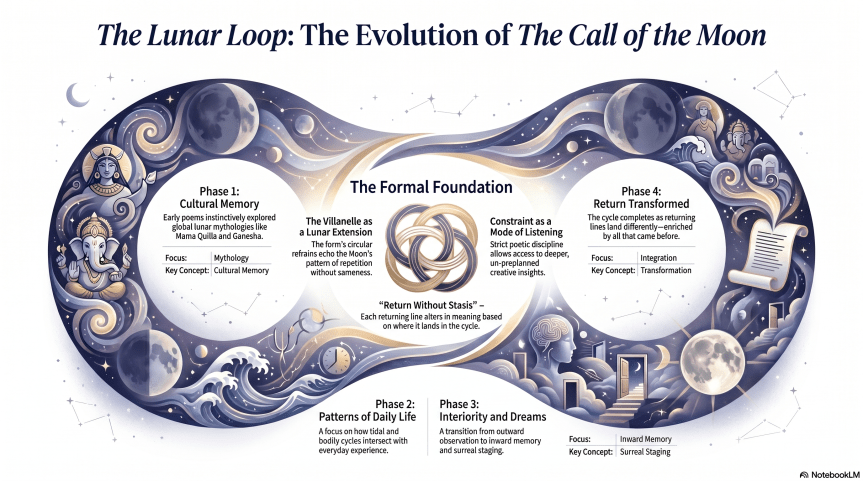
It did not begin as a “collection.” It began as a return. The Moon appeared first as an image, then as a rhythm, and eventually as a constraint I chose not to resist. The decision to write in villanelles came early, not out of technical ambition alone, but because the form itself seemed to echo what I was observing: repetition without sameness, return without stasis.
The villanelle, with its refrains and circular motion, began to feel less like a structure imposed on the poem and more like a natural extension of the lunar cycle. Each returning line altered slightly in meaning, depending on where it landed—much like the Moon itself, constant yet never identical. Writing within this form required a particular discipline. At times, the rhyme dictated direction; at other times, it resisted clarity. But in that tension, something essential emerged: the understanding that constraint can become a mode of listening.
The early poems moved instinctively toward mythology. This was not pre-planned. Figures such as Ganesha, Mama Quilla, and Baku-San entered the poems as if they were already part of the landscape I was trying to access. In retrospect, this phase now reads as a return to cultural memory—an attempt to locate the Moon not as an isolated symbol, but as something held collectively across traditions.
Writing these poems felt like gathering fragments from different worlds and allowing them to coexist within the same night sky.
Gradually, the poems began to shift. The Moon moved closer—not as a deity or mythic presence, but as something that acted upon daily life. Poems like Tumultuous Ocean and Secrets of Moonwater emerged from observing how cycles—tidal, emotional, bodily—intersect without always announcing themselves. The writing process here became more attentive to pattern and recurrence, less concerned with narrative and more with noticing.
There was also an increasing awareness that the Moon was not only outside, but also shaping an internal tempo. This marked a quiet transition in the work.
The section that now forms Moon My View was not conceived as such while writing. It was only later, during arrangement, that I recognised these poems as belonging together. They carried a different weight—more inward, more entangled with memory and relationship. The refrains in these villanelles began to feel like thoughts that returned uninvited. Writing them was not always smooth. There were moments where language circled without resolution, where meaning seemed just out of reach.
But perhaps that was the point.
The emotional core of the collection did not arrive fully formed; it revealed itself through repetition. Writing became less about articulation and more about staying with what persisted—love, doubt, longing, and the quiet reshaping of these states over time.
The final phase of the collection moved into a more fluid, almost dreamlike space. Poems such as Nocturnal Psyche of Moon and Midsummer Night’s Dream did not follow the same grounded logic as the earlier ones. They arrived with a different energy—fragmented, theatrical, at times surreal. The Moon here was no longer an object of observation or reflection; it became part of the mind’s own staging.
This shift was not deliberate, but it felt necessary.
By the time The Moon Followed Me was written, there was a sense of completion—not in the sense of closure, but in recognition. The Moon had moved from being something I wrote about to something that accompanied the writing itself. It was no longer external to the work.
Looking back, the structure of the collection—moving from myth to experience to interiority and finally to dream—was not designed at the outset. It emerged through the act of arranging, of seeing how the poems spoke to one another. The Table of Contents reflects this arc, but the arc itself was discovered only after the writing was done .
What remains most significant in this process is not the theme, but the rhythm that held it together. The villanelle, with its insistence on return, shaped not only the poems but also the way I stayed with certain ideas. It required patience, and at times, surrender.
If there is a single thread that runs through The Call of the Moon, it is this: that cycles are not repetitions of the same moment, but revisitations that alter us each time.
The Moon does not change in essence. Yet, we never encounter it in the same way twice.
Perhaps writing this collection was a way of learning to recognise that.
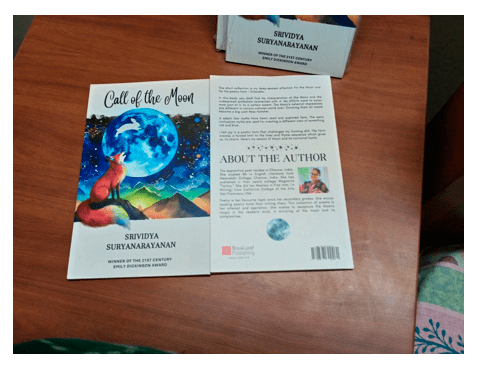
Book is available in Amazon India, Amazon US, Barnes & Nobles, Flipkart,
eBook old version in BookLeaf Publishing,
eBay au, eBay UK
Book Details
Title: Call of the Moon
Poet: Srividya Suryanarayanan
Publisher: BookLeaf Publishing
Mode: Self-Publication
Year of Publication: 2024
ISBN: 9789363300460


One thought on “Luminous Cycles: Writing the Collection “The Call of the Moon””