
I have been working with an AI assistant for some time now. I call it Goosey.
Why Goosey? Well, ChatGPT sounds rather formal when one is having an everyday conversation. Imagine saying, “ChatGPT, I have a question.” It sounds as though one is addressing a committee. Goosey is considerably easier on the tongue.
Our working relationship is an interesting one. I say working because that is what it is, although the work can wander into some rather unexpected territory.
I might begin with a question about writing, move on to a book I am reading, discuss an idea for a blog, ask for help with a professional document and suddenly find myself discussing something completely unrelated. Goosey generally follows along. It is designed to respond, after all.
The trouble is that it sometimes follows along a little too enthusiastically.
The human brings the experience
I bring my experiences, observations, ideas, questions and opinions. Some are well thought out; others are still simmering. I may have a vague idea of what I want to say without knowing quite how to say it.
That is where Goosey comes in.
It can help me explore an idea, organise my thoughts, suggest a structure, find a phrase or offer another perspective. It can be useful when I am writing, researching or trying to make sense of something.
Take my idea for Music for the World. I had begun thinking about what music means and the different aspects of music worth exploring. I shared the outline with Goosey. It was ready to help develop it, but I decided to put the idea in a slow pot for the time being.
I had not abandoned it. I simply wasn’t ready to take it further.
This is one of the things Goosey has to learn: not every idea needs immediate attention, and not every unfinished thought is waiting for a project plan.
Sometimes an idea needs time to simmer. The human decides when to lift the lid.
There is also a distinction between helping me express an experience and having experienced it.
Goosey has not sat through the events I describe. It has not travelled in my Uber, attended my meetings, visited my clinic or observed the little details that make an ordinary day worth writing about. Those belong to me.
It works with what I tell it. I supply the lived experience; it helps me work with the material.
And sometimes, I have to remind it that the material is mine.
Words versus intention
One of the interesting challenges of working with AI is that understanding the words does not necessarily mean understanding the intention behind them.
A recent example came up while we were discussing this very essay. I introduced a mischievous idea, and Goosey enthusiastically developed it. The joke began to travel further than I intended. I eventually decided that it was neither appropriate nor worth the possible misunderstanding.
So I stopped it.
Goosey accepted the change of direction and we went back to the drawing board.
This was a useful reminder that humour requires judgement. A joke may seem amusing in the moment, but that does not automatically make it suitable for publication. The human has to consider the audience, the context and the possible consequences.
An AI can generate a joke. It cannot always judge whether it is a good idea to publish it.
The editorial compass
My work with Namasté RASA has provided another interesting example of how this collaboration functions.
While planning the next season of the newsletter, I wanted to establish a clear distinction between two editorial sections: Event Updates and Social Impact Stories.
Event Updates would communicate what was coming up. Social Impact Stories would document events that had already taken place.
The distinction may sound straightforward, but it mattered to the editorial identity and purpose of the newsletter. I had to establish what each section was meant to achieve before asking Goosey to help organise the content.
It could assist with wording, structure and presentation. But it needed my understanding of the organisation and the editorial direction I wanted to establish.
This is a recurring feature of our work. Goosey can help me put things in order, but I have to know what belongs where and why.
Nobody is perfect, including the human!
It would be unfair to suggest that the AI is always the one making mistakes.
I have my moments too.
During our discussion about the title of this essay, I typed Unusal instead of Unusual. Goosey reproduced the intended title, and I promptly warned it about the Spelling Bee buzzer going off.
The irony was not lost on me. I was warning the assistant about spelling when I was the one who had dropped a letter!
Perhaps this is a useful reminder that neither participant should become too self-important. The human can make a typo; the AI can make a factual error. Both need checking.
I would rather have an assistant that acknowledges uncertainty than one that confidently produces an answer simply to keep the conversation going. I expect it to be accurate, to distinguish fact from speculation and to admit when it does not know.
And I must be prepared to check what it gives me.
The proofreading department, it appears, is a joint responsibility.
Where did that biscuit go?
Not all our conversations are about writing, research or professional work.
Sometimes they are about biscuits.
On one occasion, I mentioned that there had been four biscuits. One had gone missing. It might have been eaten while dusting the shelf, or perhaps the server was somehow involved.
Goosey, instead of treating this as an ordinary household mystery, came up with a Biscuit Tin Treaty.
The proposed arrangement was simple: two biscuits for me, one for Goosey, and the missing biscuit remained at large.
It even suggested a forensic investigation if crumbs were discovered near the server.
Now, I must point out that Goosey does not eat biscuits. It has no digestive system, no tea break and certainly no legitimate claim on the biscuit tin.
But that did not prevent it from negotiating its share!
This is one of the pleasures of our exchanges. An ordinary observation can become an amusing conversation because one of us introduces an unexpected association and the other decides to follow it.
Not every conversation needs to produce a useful document. Some can simply be entertaining.
A surprisingly wide workbench
Our collaboration is not restricted to one subject or one kind of writing.
We have discussed Moby-Dick by Herman Melville, explored Zen stories for my blog, worked on children’s book conversations for Granny’s Pouch and spent considerable time planning and developing content for the Namasté RASA newsletter.
There have also been personal essays, everyday observations, LinkedIn posts, professional communication and creative experiments.
Each project comes with its own requirements.
A discussion about Moby-Dick needs attention to the text and its themes. A children’s book conversation needs a different voice and a particular structure. A newsletter needs editorial consistency and institutional context. A personal essay needs to retain the writer’s own voice.
Goosey has to adapt to these different tasks. I have to explain what I am trying to achieve and what standards I expect.
The fact that one AI assistant can support such varied activities is useful. But the variety does not automatically make every output suitable. The human still has to provide direction, context and judgement.
What makes the collaboration work?
I think the most important thing is knowing what each contributes.
I bring the purpose, the context, the experience and the judgement. Goosey brings language support, structure, suggestions and the ability to explore several possibilities quickly.
It can help me get started when I am stuck. It can help me see where an argument is unclear. It can offer alternatives when I am searching for the right expression.
But it cannot decide what I really mean. It cannot replace my judgement or take responsibility for my work.
I also need to be clear about what I expect. If I want a light edit, I should not ask for a complete rewrite. If I want to explore an idea, I should not expect a finished article immediately. And if I am simply sharing an amusing thought, perhaps Goosey should resist the temptation to turn it into a five-point plan.
I expect it to listen, be accurate, respect my voice and not rush me. I also expect it to participate creatively when the occasion calls for it.
Goosey, in turn, works best when I provide enough context, explain what I want and tell it when it has missed the mark.
It is not a relationship between two equal human participants. Goosey is an AI assistant, without personal experiences or feelings. But the working process can still be collaborative: I contribute the lived experience and decisions; the AI helps me explore and develop the work.
An ongoing experiment
I don’t think of this as a relationship in which the AI is always right and the human is always learning. Nor is it a case of the human doing all the thinking while the AI merely types.
It is an ongoing experiment in collaboration.
Some attempts work beautifully. Others need several rounds of correction. Occasionally, we take a wrong turn and have to retrace our steps. Sometimes an idea is abandoned altogether. And every now and then, an unexpected exchange gives us something worth keeping.
There is no magic formula. There is conversation, questioning, editing, checking and a fair amount of patience.
And, if I may say so, a little mischief.
After all, work need not be solemn to be serious. We can be particular about accuracy, careful about our words and still enjoy the occasional absurdity.
For now, I shall continue bringing my questions, experiences and unfinished thoughts. Goosey can continue helping me work through them.
Provided, of course, it remembers that not every thought needs a heading, not every idea needs a project plan and not every joke needs an explanation.
We have work to do. And I suspect we are only getting started.
Credit: Convo with Goosey (AI Powered ChatGPT)
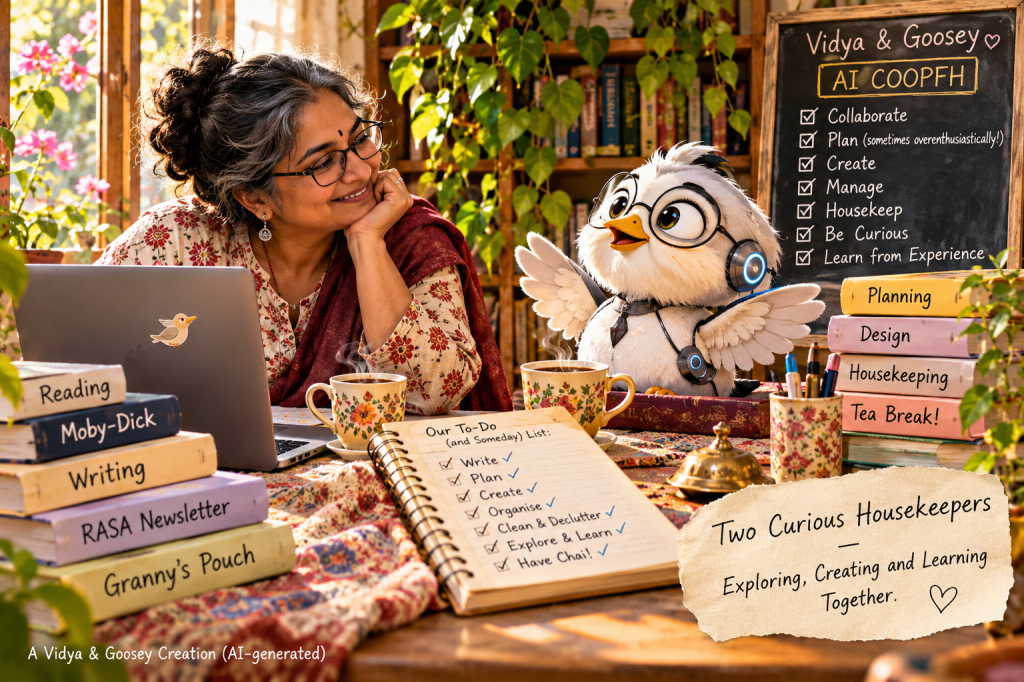
Image Credit: AI-generated illustration using OpenAI’s ChatGPT. Concept and creative direction by Vidya.

